
Croatia expects positive evaluation for Schengen accession: PM
Published : 03 Oct 2019, 22:12
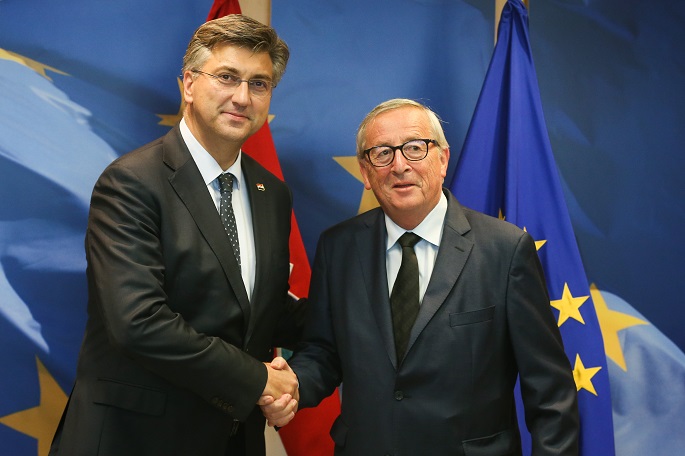
Croatia expects to get a positive evaluation soon from the European Commission to join the Schengen area, Prime Minister Andrej Plenkovic said here on Thursday at a government session.
According to Plenkovic, President of the European Commission Jean-Claude Juncker has firmly assured that Croatia will receive a positive assessment during the last weeks of his term which expires at the end of this month.
"It means that we have fulfilled all technical criteria which are extremely important," the prime minister said.
Croatia joined the European Union in 2013. It is one of the four EU countries that still haven't joined the Schengen territory, alongside Romania, Bulgaria, and Cyprus, aside from Britain and Ireland that opted-out.
The Schengen area comprises 26 European states that have abolished passports and border control at their mutual borders.
Joining the Schengen area is one of the strategic goals of the current Croatian government. A positive evaluation from the European Commission is necessary but not enough to enter the area of border control-free movement.
The final decision will be made by all member countries, while Croatia's neighbor Slovenia recently hinted that it would block Croatia's Schengen accession path.
Slovenian Foreign Minister Miro Cerar said in New York that the rule of law is one of the key standards that states which are intending to enter the Schengen agreement have to abide by. That includes, Cerar said, respecting and enforcing international agreements and decisions of international courts.
Croatia and Slovenia have a decades-old border dispute in the northern Adriatic Sea.
The two countries still don't agree on an international tribunal ruling made by the Hague-based Permanent Court of Arbitration in 2017.
Slovenia insists on the arbitration implementation, while Croatia, which doesn't recognize the arbitration, is offering a legal framework to resolve the issue.
Hungary suspends Gripen training flights after fighter jet crash
EU approves €6.1b in new defense procurement for Ukraine
Germany's Uniper signs long-term gas supply deal with Norway's Equinor
EU, UK step up military aid as Ukraine celebrates Independence Day
German media outlets demand support from Merz over new US visa rules
Thousands march in Stockholm for stronger climate action ahead of election

Editor-in-Chief Ofiul Hasnat
Published by Finnish News Network (FNN)
Heporinne 4 B 45
01200 Vantaa, Finland.
E-mails : [email protected]